
Commingling in Real Estate: A California Legal Guide
A daughter comes into my office after her father dies. She's trying to do the right thing. She has his rental records, a stack of bank statements, and a growing sense that something is wrong. Rent checks went into his personal account. Security deposits seem to have been used to pay ordinary household bills. One account shows money moving back and forth with no clear labels. Nobody is alleging theft yet, but everyone is worried.
That situation is common in probate, trust administration, and family property disputes across California. The legal problem is often commingling. In plain English, that means money or property that should have been kept separate got mixed together. Once that happens, simple administration can turn into a serious dispute over ownership, fiduciary duties, reimbursement, and liability.
For families in Orange County and Los Angeles, commingling in real estate can affect far more than a broker's trust account. It can affect an inherited rental property, a family trust, a surviving spouse's property rights, or the classification of money that was supposed to remain separate property. If you're dealing with an estate, a trust, or a disputed property account, clarity matters early.
I want to walk through this the same way I would explain it to a concerned client under California law. You need to know what commingling is, where it happens, why courts and regulators take it seriously, and what steps can help fix the problem before it gets worse. If you suspect funds were mixed in a probate, trust, landlord-tenant, or marital property situation, get legal advice promptly and schedule a free consultation.
Table of Contents
- Introduction A Common but Costly Real Estate Mistake
- What Is Commingling Under California Law
- Common Commingling Scenarios in Real Estate and Estates
- The Serious Legal Consequences of Commingling
- How to Prove Commingling and Seek Legal Remedies
- Best Practices to Prevent Commingling
- Get Help with Your Orange County Real Estate Matter
Introduction A Common but Costly Real Estate Mistake
A family usually doesn't discover commingling during a calm moment. They find it in the middle of a crisis. A parent has died. A trustee is being questioned by siblings. A spouse is preparing for divorce. A rental property has been mismanaged, and the records don't match the balances in the account.
In California, that kind of mixing creates immediate legal risk because people in positions of trust are expected to handle money carefully and transparently. If an executor deposits estate rent into a personal checking account, or if a trustee pays a personal credit card bill from trust funds and intends to “pay it back later,” the problem starts before anyone proves fraud. The act of mixing itself can damage the paper trail and undermine confidence in the person handling the funds.
Commingling cases often begin with a simple sentence from a client: “I can't tell whose money this was supposed to be.”
That's why this issue matters so much in real estate and probate. Real property generates deposits, rents, mortgage payments, repair expenses, sale proceeds, and inherited equity. When those funds are handled through the wrong account, every later question becomes harder. Who owned the funds? Who was entitled to them? Was a payment proper? Can the money still be traced?
For families, this is more than an accounting dispute. It can delay probate, increase conflict between beneficiaries, create exposure for trustees and agents, and put separate property claims at risk. The sooner the records are reviewed, the more options you usually have.
If you believe someone mixed real estate, estate, trust, or marital funds in California, don't wait for the confusion to deepen. A careful legal review can identify the problem, preserve evidence, and help protect your rights. If you're facing that situation in Orange County or Los Angeles, schedule a free consultation.
What Is Commingling Under California Law
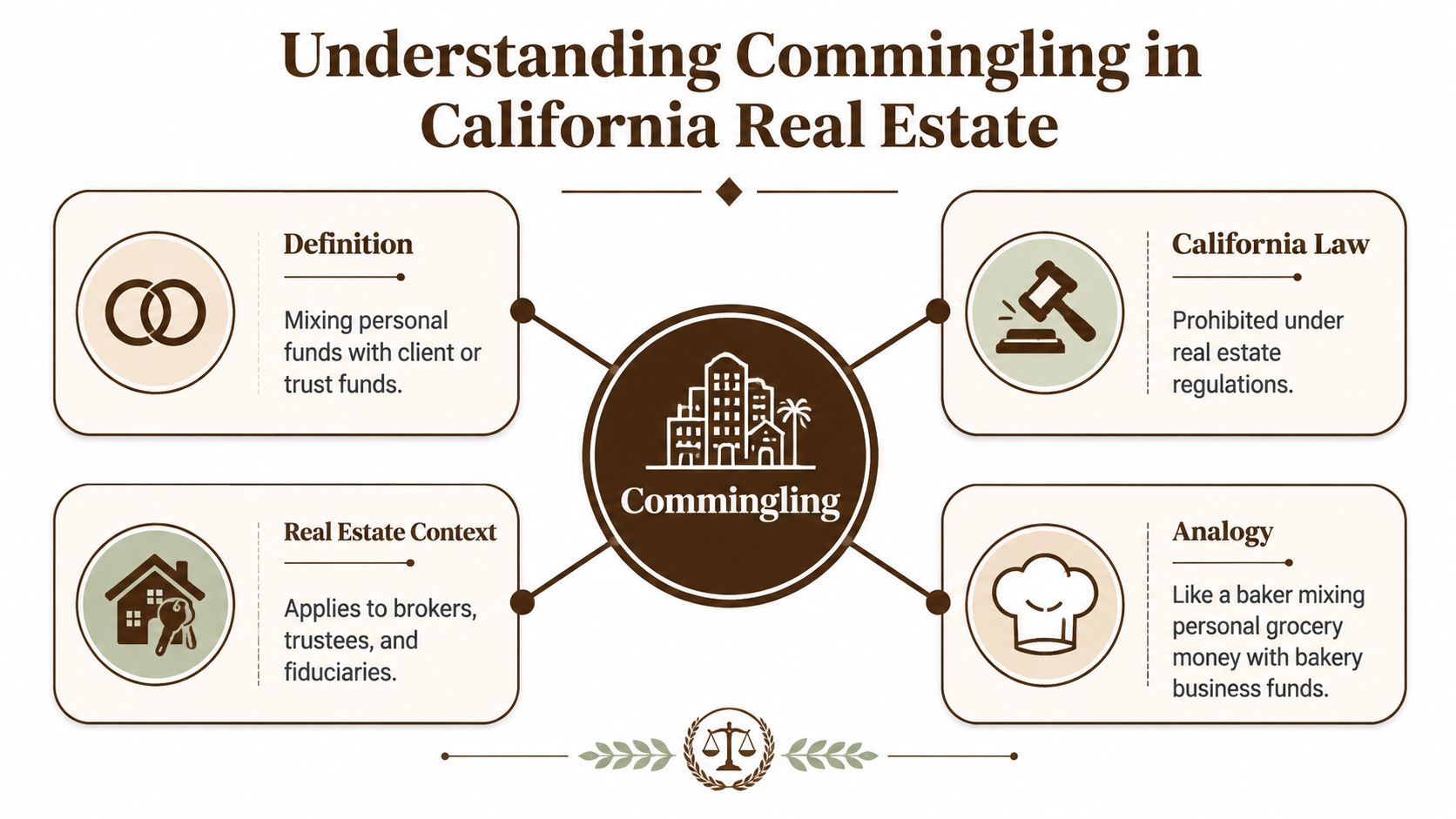
Commingling means mixing money or property that should be kept separate. In real estate settings, that often means client or trust money gets placed into a personal account or an operating account. In family disputes, it may mean inherited funds or trust assets were blended with marital or personal funds.
A simple analogy helps. Think about a baker who sells bread at a neighborhood shop. If the baker drops the day's business receipts into the same envelope used for family grocery cash, the money becomes harder to identify. Even if the baker plans to sort it out later, the records are already compromised. That is the basic concern behind commingling in real estate.
Mixing is the problem
Under California law, intent matters in some claims, but mixing itself can be enough to create serious legal trouble for a fiduciary. That is why this issue is treated so seriously in brokerage, trust administration, probate, and property management. A foundational historical reason commingling matters in real estate is that client-money separation is treated as a core brokerage duty, and guidance emphasizes that mixing client funds with personal or operating money can trigger license discipline even when no theft was intended, as discussed in Azibo's overview of commingling in real estate.
For California clients, that principle is familiar across several legal roles:
- Real estate brokers must keep client funds properly segregated.
- Trustees and executors must handle estate or trust money for the benefit of others, not for personal convenience.
- Agents and property managers must preserve a clean record of who owns what.
Commingling is not the same as conversion
Clients often confuse commingling with conversion. They are related, but they are not identical.
| Term | Plain-English meaning | Why it matters |
|---|---|---|
| Commingling | Funds that should be separate are mixed together | It destroys clarity and can itself violate fiduciary duties |
| Conversion | Someone wrongfully uses money or property that belongs to another | It creates a direct claim for return of money or damages |
A trustee who deposits trust money into a personal account may have committed commingling, even if no personal spending happened yet. If that trustee then uses the funds for a private expense, the conduct may also become conversion.
Practical rule: If you are handling money that belongs to an estate, trust, client, or another owner, keep it in the correct account from the start. Trying to “sort it out later” is where many California disputes begin.
In probate and property disputes, that distinction often shapes the lawsuit, the remedy, and the defense. If you're unsure whether a questionable transaction was merely sloppy bookkeeping or a legally actionable breach, get advice specific to California law and schedule a free consultation.
Common Commingling Scenarios in Real Estate and Estates
Commingling in real estate doesn't always look dramatic at first. Most cases begin with convenience, haste, or poor systems. Then a sale, death, dispute, or audit forces everyone to examine the records.
A broker mixes a buyer deposit with business funds
A broker receives earnest money from a buyer. The funds should go where they belong, with clear handling and documentation. Instead, someone in the office deposits the money into the brokerage operating account because it's “just temporary.”
That single shortcut can create a chain reaction. The operating account pays payroll, subscriptions, rent, and ordinary office bills. Once the buyer's deposit enters that stream, the money is no longer cleanly segregated. In California, regulators don't treat that as a harmless filing mistake.
Many states allow a small amount of the broker's own money in a trust account to cover bank service charges, and monthly reconciliation is treated as a core compliance step, as explained in Speicher Group's discussion of real estate commingling risks. That edge case confuses people. They hear about limited bank-fee seed money and assume broader mixing is acceptable. It isn't.
A property manager puts tenant funds in the wrong account
A landlord hires a property manager to collect rent and hold tenant security deposits. The manager uses a personal bank account or a general household account because it seems easier than opening a dedicated holding account.
The legal risk appears immediately. Security deposits and rental receipts often involve money held for another person or for a defined purpose. If the property owner later dies, the probate estate may inherit not only the property but also the recordkeeping disaster.
Short operational problems can also trigger bigger ones:
- Auto-sweeps by banking platforms can move balances unexpectedly.
- Misrouted digital deposits can place funds in the wrong account for days.
- Multiple-owner properties can blur which receipts belong to which owner.
These are the kinds of details that matter when a California court or opposing counsel starts tracing the account history.
An executor or trustee treats estate money like personal money
This is the pattern I see most often in probate-adjacent disputes. A son becomes trustee after his mother dies. He opens no separate estate or trust account. He deposits rent from her duplex into his personal account and pays repair bills from that same account. He insists he kept mental track of everything.
Mental track is not a legal system.
When a fiduciary handles money for beneficiaries, record separation isn't optional. Beneficiaries are entitled to know what came in, what went out, and why. If personal and fiduciary transactions share one account, every disbursement becomes suspect. Even an honest trustee can face serious accusations because the records invite doubt.
A spouse deposits separate property into a joint account
Families are often surprised to learn that commingling isn't limited to brokers and trustees. It also arises in marriage. One spouse receives an inheritance or brings separate funds into the marriage. Later, that money goes into a joint account used for family mortgage payments, groceries, repairs, and travel.
The issue then becomes characterization under California law. Was the money still separate property, or did the account history blur it so badly that a tracing fight is now required?
In these disputes, the legal battle is often less about intent and more about proof.
That is why families dealing with probate, estate planning, or marital property should treat account structure as a legal issue, not an administrative detail. If any of these scenarios sound familiar, get legal advice before records disappear and schedule a free consultation.
The Serious Legal Consequences of Commingling
People often assume commingling is a minor bookkeeping defect. California law treats it much more seriously when a fiduciary relationship or ownership dispute is involved. Once funds are mixed, the consequences can spread into licensing, civil liability, trust disputes, and property characterization battles.
Breach of fiduciary duty
A fiduciary owes a high duty of loyalty, care, and honesty. Trustees, executors, brokers, and certain agents must act for the benefit of others, not for personal convenience. When they mix entrusted funds with their own money, they compromise the transparency that fiduciary law depends on.
In real estate brokerage and property management, commingling is viewed as a controls failure, not just a bookkeeping problem. Guidance commonly calls for a monthly three-way reconciliation of the trust-account ledger, check register, and bank statement to detect shortages or accidental disbursements before they become fiduciary breaches, as described in US Realty Training's explanation of trust-account controls.
Conversion and other civil claims
If mixed funds are later spent, withheld, or cannot be returned when demanded, a plaintiff may assert conversion or related claims. That usually means the dispute has moved beyond poor recordkeeping and into wrongful use of another person's money.
A common example involves sale proceeds or rents that should have been held for an estate or co-owner. Once the funds enter a personal account and get used for unrelated expenses, the harmed party may seek restitution, damages, and an accounting.
Professional discipline and licensing risk
For California brokers and others who handle entrusted real estate funds, commingling can trigger professional discipline. That can include investigations, formal accusations, and threats to a professional license. Even where no theft is alleged, regulators and courts may treat the failure to maintain separation as evidence that the fiduciary cannot be trusted with client money.
The practical lesson is plain. Clean systems protect both the client and the professional.
Loss of property characterization
Commingling can also weaken ownership claims. In divorce, probate, and trust litigation, a party may argue that money or property once identifiable as separate has become too mixed to classify cleanly. That doesn't mean every separate-property claim is lost, but it does mean the burden of proof becomes harder.
Consider the difference:
- Clear separation supports a straightforward ownership argument.
- Mixed accounts with poor records invite tracing disputes.
- Long periods of undocumented transfers increase the risk of losing part or all of a claim.
A court can't protect what the records no longer identify.
If you are a beneficiary, co-owner, spouse, trustee, broker, or executor facing these risks in California, don't assume the issue will resolve itself. Prompt legal analysis can protect evidence and narrow the dispute. Schedule a free consultation.
How to Prove Commingling and Seek Legal Remedies
A common call to our office starts like this. A son acting as trustee sold a rental property after his mother died, deposited the sale proceeds into his personal account "just for a few days," and now his siblings want to know what happened to the money. In a divorce case, the pattern looks different but the problem is similar. One spouse says a down payment came from separate-property savings, but years of transfers through a joint account have blurred the paper trail.
In both situations, the case turns on proof.
Courts want a clean story supported by records. If commingling is the legal problem, tracing is the method used to prove it. Tracing means following money from its source to its final use, step by step, until the court can see whether funds stayed separate, were mixed, or were spent for an unauthorized purpose. For families in probate, trust administration, or marital property disputes, that question often matters just as much as the amount of money involved. It can decide who owns an asset, who must repay funds, and whether a fiduciary kept faith with the family.
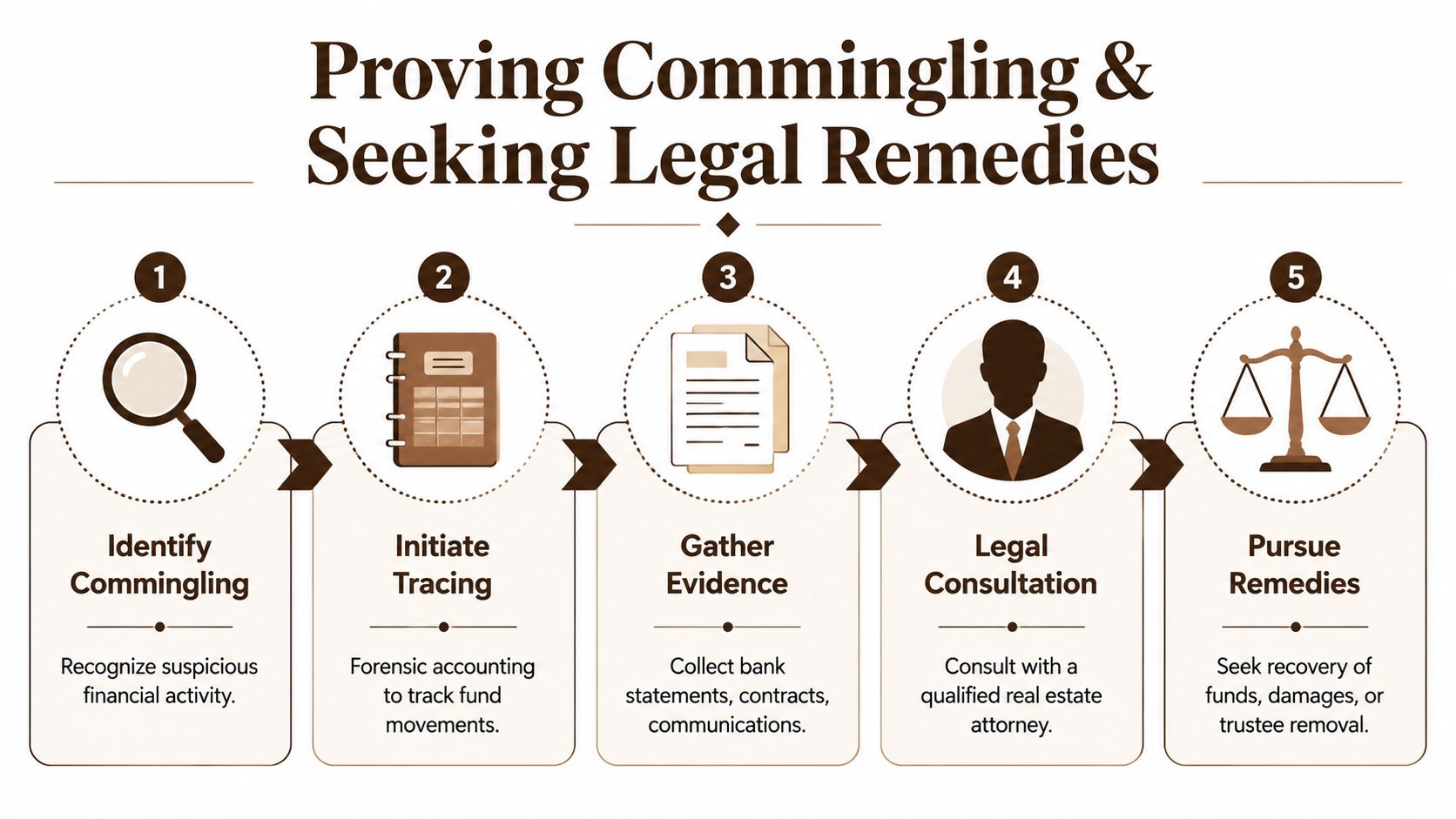
Tracing works much like reconstructing a property title history. You do not look at one document and guess. You line up each transfer in order until the ownership story makes sense. Money cases work the same way. A single bank statement rarely proves enough on its own. The pattern over time is what matters.
A useful tracing file often includes:
- Bank statements showing deposits, transfers, withdrawals, and running balances
- Closing statements from sales, purchases, or refinances
- Lease agreements, rent ledgers, and deposit records for income-producing property
- Trust accountings, probate filings, and fiduciary reports
- Checks, wire confirmations, invoices, and receipts tied to disputed transactions
- Emails and text messages explaining why money was moved and who approved it
Good records do more than show where money went. They also help answer the questions that usually decide these cases under California law. Was the money trust property, estate property, community property, or separate property. Was there consent. Was the transfer temporary bookkeeping, or was it actual personal use. Did the fiduciary keep enough documentation to explain each movement of funds.
Those details matter because commingling disputes are rarely just accounting exercises. In probate litigation, tracing may show that sale proceeds belonging to an estate were used to pay a personal mortgage. In a trust dispute, it may show that rental income from trust real property was deposited into a trustee's own checking account. In a divorce matter, tracing may help establish that one spouse can still identify separate-property contributions despite years of mixed deposits and withdrawals.
Some defendants try to blur the issue by arguing that pooled money is common in real estate deals. That can be true in the commercial investment context when investors knowingly agree to a defined structure. Unauthorized mixing is different. As explained in FNRP's discussion of commingling in commercial real estate, disclosed pooling among investors is not the same as a fiduciary placing client, estate, or trust funds into a personal account.
If the evidence shows improper mixing or misuse, California courts may provide several remedies.
| Remedy | What it means in plain language | When it may help |
|---|---|---|
| Accounting | The court orders a full record of money received, spent, and transferred | Helpful when a trustee, agent, co-owner, or personal representative has incomplete or questionable records |
| Restitution | Money or value wrongfully taken or used must be repaid | Useful when the loss can be identified and measured |
| Quiet title | The court decides competing claims to real property ownership | Used when mixed funds affect title, beneficial ownership, or the source of purchase money |
| Partition action | Co-owned property is divided or sold under court supervision | Helpful when owners disagree about shares, contributions, or rights to sale proceeds |
Other remedies may follow from the same facts. A court can remove a trustee or personal representative who failed to handle funds properly. A judge may impose a constructive trust over property acquired with misused money. In the right case, attorney's fees may also be recoverable if a statute, contract, or fiduciary claim allows it.
The first practical step is usually narrower than people expect. Preserve statements, account access records, escrow papers, and communications before anything disappears. Then stop any further mixing if you have the authority to do so.
For Orange County families, this part often feels personal because it is personal. A commingling case is rarely about bookkeeping alone. It is often about whether a parent's estate was handled properly, whether a sibling overstepped, or whether separate property can still be identified after years of marriage. Clear legal analysis early in the dispute can protect evidence, define the claim, and put the court in a position to sort out ownership and repayment.
Best Practices to Prevent Commingling
The safest commingling dispute is the one that never starts. Prevention depends less on complex law and more on disciplined habits. In California real estate, probate, and family property matters, good separation practices reduce risk before conflict begins.
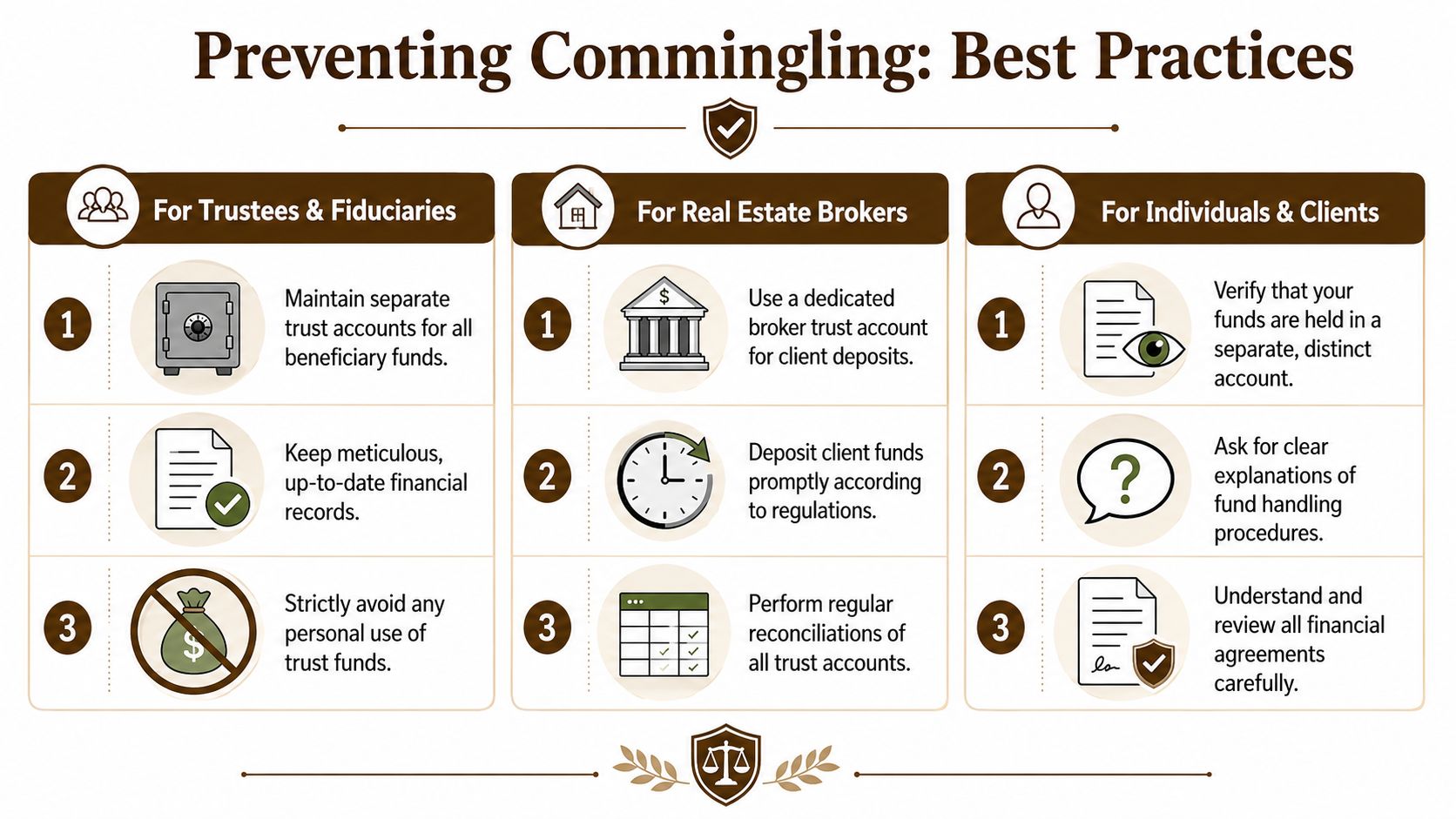
For a visual summary, this checklist helps illustrate the basics.
For trustees and executors
If you're managing estate or trust property, open the correct account promptly and use it only for estate or trust business. Don't deposit rent, refunds, sale proceeds, or reserve funds into your own checking account, even briefly.
A useful working checklist looks like this:
- Open a dedicated account early: Use an account titled to the trust or estate, not to yourself personally.
- Pay only fiduciary expenses from that account: Repairs, taxes, insurance, and approved distributions should be documented.
- Keep source records: Save invoices, statements, receipts, and notes explaining unusual transactions.
For brokers and property managers
Systems matter. Real estate professionals should treat segregation and reconciliation as operating disciplines, not occasional clean-up tasks. The industry's longstanding resistance to “mixing” appears not only in money handling but also in listing practices. The National Association of REALTORS®’ longstanding rule against commingling MLS and non-MLS listings drew renewed Department of Justice scrutiny in 2024, reflecting how firmly anti-commingling rules are embedded in real estate market structure, as reported by HousingWire's coverage of DOJ and NAR scrutiny over commingled listings.
That broader pattern reinforces a simple point. Separation rules are central to this industry.
Consider these habits:
- Use the proper trust or escrow structure: Don't rely on operating accounts for convenience.
- Review account activity on a schedule: Regular reconciliation catches shortages, stale items, and mispostings early.
- Monitor software settings carefully: Rent-collection tools and property-management platforms can help maintain audit trails, but auto-routing features still need human oversight.
This short video may also help you think about practical compliance habits in day-to-day operations.
For spouses, heirs, and individual owners
Families often create commingling problems without realizing it. An inheritance gets dropped into the joint household account. A parent adds a child to an account “for convenience.” Sale proceeds from one property are mixed with renovation funds for another. Years later, nobody can prove the original source.
Keep separate property separate in both title and practice.
That means separately titled accounts, clear transfer memos, and restraint. If money is meant to stay separate, don't use it as the family catch-all account. If you want to preserve ownership rights, the paperwork needs to match the intention.
If you want to prevent a dispute before it reaches probate court or a property lawsuit, legal guidance at the start is often less costly than reconstruction later. If you're in Orange County or Los Angeles and want help setting up safer practices, schedule a free consultation.
Get Help with Your Orange County Real Estate Matter
Commingling in real estate can start with one careless deposit and end in a fight over ownership, fiduciary misconduct, beneficiary rights, or reimbursement. In California, those disputes are especially serious when they involve a trust, probate estate, rental property, inherited funds, or separate property claims between spouses.
What makes these cases difficult is that the legal issue and the factual issue are tied together. You need to know the law, but you also need to rebuild the money trail. That takes careful review of accounts, property records, communications, and the role each person was supposed to play. Families trying to untangle this on their own often lose time, miss evidence, or make a preventable mistake in the middle of an already stressful dispute.
For Orange County and Los Angeles clients, experienced counsel can help identify whether the problem is poor bookkeeping, breach of fiduciary duty, conversion, or a title and ownership dispute requiring court action.

If you suspect commingling involving a home, rental property, trust, estate, or marital asset, get answers before more records disappear and positions harden. A focused legal review can often clarify what happened, what can be proven, and what remedies may be available under California law. Schedule a free consultation.
If you need guidance on commingling, probate-related real estate disputes, quiet title issues, partition actions, or fiduciary misconduct in Orange County or Los Angeles, contact Tanner Law to schedule a free consultation.