Joint Tenancy vs Tenants by the Entirety: Estate Planning
You're filling out closing paperwork for a home in Orange County or Los Angeles, and one line suddenly feels much more important than the purchase price, the loan rate, or even the move-in date: How do you want to hold title?
Most families pause there. That's reasonable. The title choice affects what happens if one owner dies, whether probate can be avoided, whether one owner can act alone, and how exposed the property may be if debt or litigation enters the picture. People often search for joint tenancy vs tenants by the entirety because they've heard one of these options offers stronger protection. The California answer is more nuanced.
California homeowners need to know one central point early. Tenancy by the entirety is not a California title option. It exists in about half of U.S. states plus the District of Columbia, but California uses different ownership rules for married couples. That means a California family comparing title choices shouldn't stop at joint tenancy. They should also look closely at community property with right of survivorship, which is often the more useful comparison in this state.
Table of Contents
- Choosing Your Path to Homeownership in California
- The Foundation of Co-Ownership The Right of Survivorship
- A Detailed Comparison of Joint Tenancy and Tenancy by the Entirety
- The California Alternative Community Property with Right of Survivorship
- Common Risks and Related Property Litigation
- How to Choose and Update Your Property Title
- Frequently Asked Questions about California Property Co-Ownership
Choosing Your Path to Homeownership in California
A couple buying their first home in Irvine, Long Beach, Pasadena, or Santa Ana often expects the hard decisions to be about budget, inspections, and loan approval. Then escrow sends over vesting instructions, and now they're choosing a legal structure that may control the property for years.

For many families, the question sounds technical but feels personal. If one spouse dies, will the house pass automatically? If one owner gets sued, can the other owner lose the home too? If the marriage later changes, does the title still make sense? Those aren't abstract concerns in Southern California, where a home is often the family's largest asset.
The title line is doing more work than people realize
On paper, vesting can look like a simple label. In practice, it controls survivorship rights, transfer rights, creditor exposure, and tax consequences. A bad fit can create problems years later, often at the worst possible time, such as death, divorce, refinancing, or a family dispute.
California families also run into a second problem. They search online and find articles praising tenancy by the entirety, only to discover that the option doesn't apply here. That creates confusion, especially for people moving from another state or inheriting property elsewhere.
A title choice should match the family's real plan for the property, not just the fastest box to check in escrow.
In California, the practical comparison usually isn't just joint tenancy versus tenants by the entirety. It's joint tenancy versus community property with right of survivorship for married couples, and joint tenancy versus tenancy in common for many non-married co-owners. Understanding the out-of-state concept still matters, because it helps explain what protections California does and does not offer.
The Foundation of Co-Ownership The Right of Survivorship
Both joint tenancy and tenancy by the entirety are built around one feature families care about immediately: the right of survivorship. That means when one owner dies, the deceased owner's interest passes automatically to the surviving owner or owners instead of passing through probate.
Why survivorship matters
This is the practical attraction. According to ElderLawAnswers on tenancy by the entirety and joint tenancy, tenancy by the entirety is recognized in about half of U.S. states plus the District of Columbia, while joint tenancy is available to any two or more people, not just married couples. The same source notes that both forms avoid probate at death, but tenancy by the entirety is narrower and more protective because it can block action by one spouse acting alone.
That probate-avoidance feature is why joint tenancy is so common on California deeds. A surviving spouse, partner, parent, or sibling may be able to establish ownership more directly than if the deceased owner held title alone.
The four unities in plain English
Joint tenancy has a traditional legal framework often described as the four unities. Lawyers use that phrase because joint tenancy works best when all owners take title in the same way at the same time.
Here's the plain-English version:
- Time: The owners acquire their interests at the same time.
- Title: They take ownership through the same deed or instrument.
- Interest: They hold equal interests.
- Possession: Each has equal rights to possess the whole property.
If that sounds old-fashioned, it is. But the concept still matters because it explains why joint tenancy is structured as a shared ownership with survivorship, rather than separate slices passing through each owner's estate.
A simple example helps. If two people buy a house as joint tenants, each has an equal ownership interest and an equal right to use the property. If one dies, the survivor takes full ownership by operation of law.
Practical rule: Survivorship helps avoid probate, but it doesn't answer every issue. It doesn't tell you whether one owner can transfer an interest alone, how creditors are treated, or whether the title is tax-efficient in California.
That's why families shouldn't stop after hearing “it avoids probate.” Probate avoidance matters, but it's only one piece of the analysis.
A Detailed Comparison of Joint Tenancy and Tenancy by the Entirety
Even though tenancy by the entirety isn't available in California, understanding it is still useful. Clients relocating from states like Florida, New York, Pennsylvania, or Virginia often assume California offers the same title protections. It doesn't. That misunderstanding can lead to serious planning mistakes.
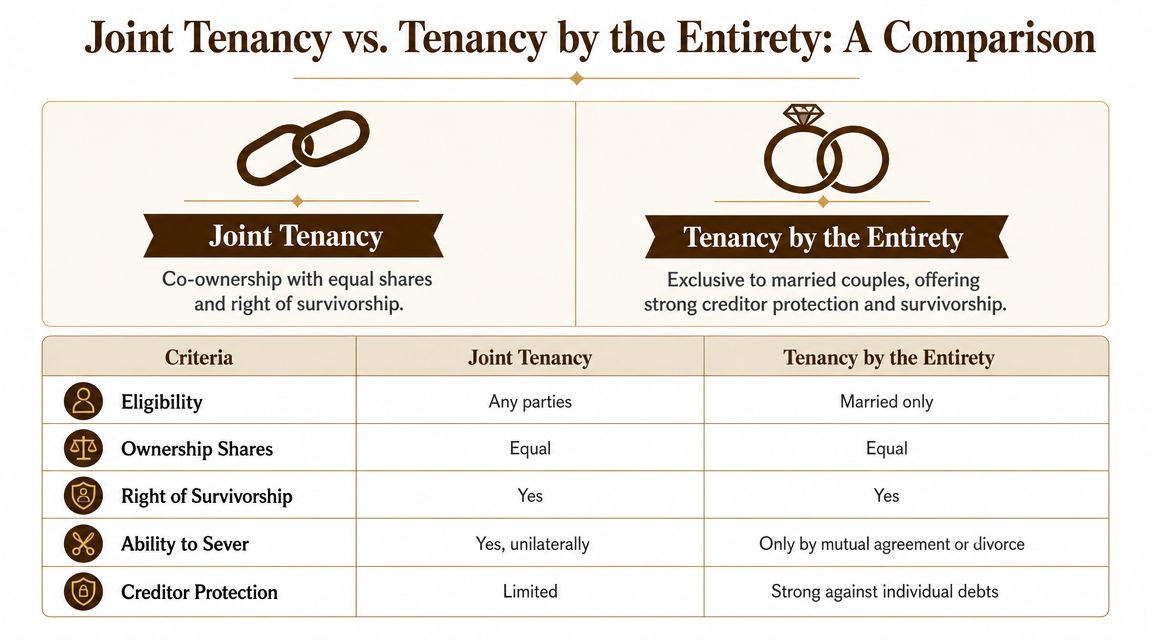
Quick comparison table
| Issue | Joint Tenancy | Tenancy by the Entirety |
|---|---|---|
| Who can use it | Any two or more co-owners | Married spouses only in states that recognize it |
| Survivorship | Yes | Yes |
| Probate avoidance at death | Yes | Yes |
| Can one owner act alone | Often yes, depending on the act | No, major actions generally require both spouses |
| Creditor exposure | One owner's interest may be vulnerable | Usually stronger protection against one spouse's separate creditor |
| Availability in California | Yes | No |
Where the real differences show up
The first difference is eligibility. Joint tenancy is flexible. Friends, siblings, unmarried partners, and married couples can all use it. Tenancy by the entirety is much narrower because it is reserved for married couples in jurisdictions that allow it.
The second difference is control. Joint tenancy allows more freedom, but also more risk. One joint tenant may be able to transfer that person's interest and thereby disrupt the survivorship arrangement. Tenancy by the entirety is far more restrictive. According to Ozarks Law Firm's discussion of joint tenancy and tenancy by the entirety, each spouse is treated as owning 100% of the property rather than a 50/50 split, and both spouses must consent to major actions such as selling or mortgaging the home.
In tenancy by the entirety, the law treats the married couple as a single legal unit for ownership purposes. That's the feature California readers usually have in mind when they ask why one spouse's creditor often can't force a sale.
The third difference is the one that gets the most attention: creditor protection. Joint tenancy usually does not give the same shield. If one joint tenant has debt problems or a judgment entered against them, that owner's interest may become a target. Tenancy by the entirety is often described as stronger because a creditor of only one spouse typically cannot reach the property in the same way.
That protection is important, but it's not magic. A couple with joint obligations still has exposure. A lender holding a consensual mortgage is in a different position from a single-spouse unsecured creditor. Asset protection always depends on the kind of debt, the governing state law, and how title was created.
A short explainer can help:
- Joint tenancy works well when co-owners want survivorship and broad eligibility.
- Tenancy by the entirety works well when married couples in a qualifying state want survivorship plus stronger barriers against unilateral action.
- Neither form solves every estate-planning issue if the family also wants trust planning, tax efficiency, and long-term management instructions.
Here's a useful overview for families who prefer video before reading deed language in detail:
Why California families still need to understand TBE
The phrase joint tenancy vs tenants by the entirety matters in California mostly as a comparison point. It shows what protections other states may offer and why California couples should review their deeds more carefully instead of assuming all survivorship-based ownership works the same way.
For a California married couple, the better question is often this: if tenancy by the entirety isn't available here, what title gives us the right combination of survivorship and tax treatment?
That usually leads to community property with right of survivorship.
The California Alternative Community Property with Right of Survivorship
California is a community property state, and that matters. Married couples in California often have a title option that lines up better with California law than standard joint tenancy does: community property with right of survivorship.
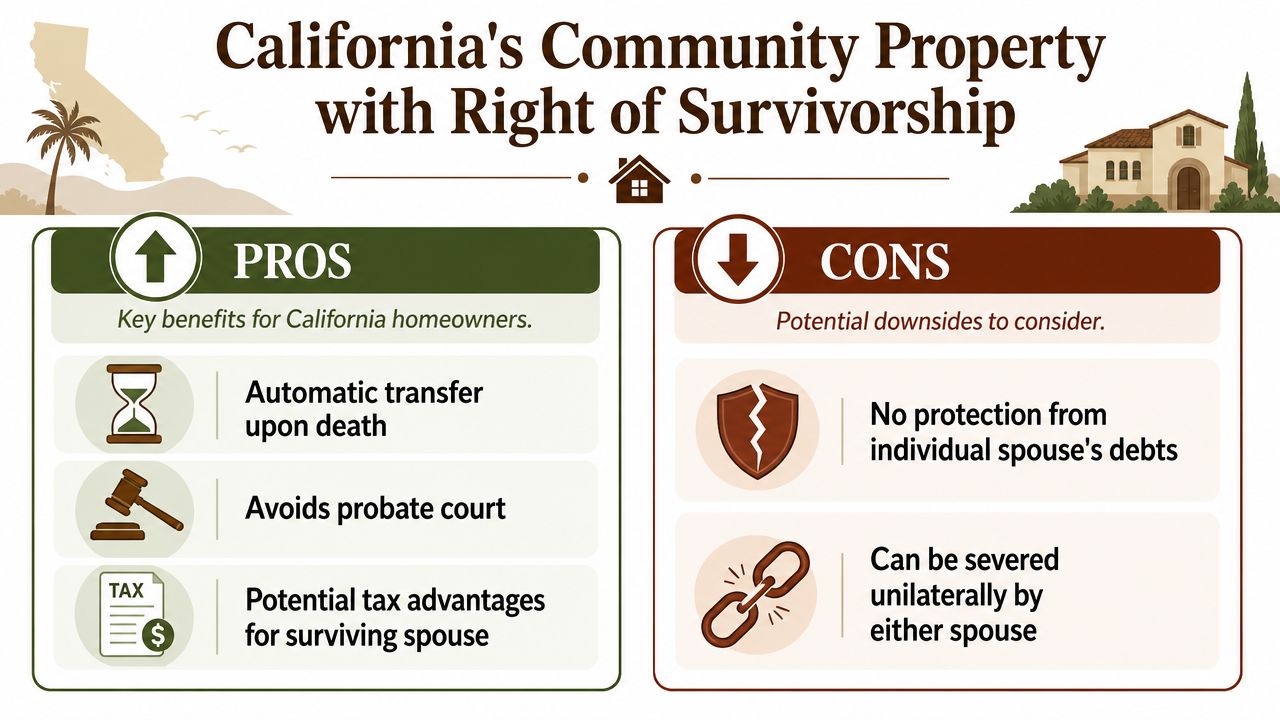
Why many California married couples prefer this option
For many married homeowners in Orange County and Los Angeles, this form of title addresses two goals at once. It allows the property to pass automatically to the surviving spouse, and it usually fits California's community property system more naturally than joint tenancy.
The tax issue is often where the decision becomes clear. In practice, many California estate-planning attorneys favor community property with right of survivorship because of the step-up in basis advantages associated with community property treatment at the first spouse's death. That can make a significant difference when the surviving spouse later sells the home. The key point for families is simple: joint tenancy and community property with right of survivorship don't always produce the same tax result.
That doesn't mean community property with right of survivorship is automatically best in every file. It means married California couples shouldn't default to joint tenancy just because the phrase sounds familiar.
What it does not do
Some families over-assume. California's community property with right of survivorship is not the same thing as tenancy by the entirety.
According to Rocket Mortgage's explanation of tenancy by the entirety limits, tenancy by the entirety generally blocks unilateral transfer and shields a home from one spouse's separate creditors, but its protection is not absolute. Joint debts remain exposed, and TBE commonly converts to a less protective form of ownership upon divorce. That's a useful reminder because people often speak of TBE as if it were a complete shield. It isn't.
For California readers, the practical takeaway is sharper. Since California doesn't offer TBE, a married couple using community property with right of survivorship should not assume they've obtained TBE-style creditor protection. They haven't. The benefits are real, but they are different.
If your main concern is California tax treatment between spouses, community property with right of survivorship often deserves priority review. If your main concern is creditor insulation like the kind discussed in TBE states, California law requires a different strategy.
A second point matters during divorce or separation. Title that worked perfectly during marriage may become awkward once spouses no longer want automatic survivorship. In that setting, the deed, family law orders, and broader estate plan need to be updated together. If only one piece changes, the family can end up with conflicting documents and expensive cleanup later.
Common Risks and Related Property Litigation
Title choices don't stay on paper. They eventually collide with life. A co-owner wants to sell, the other refuses. A deceased owner's children claim the deed was wrong. A creditor records a judgment. A trust transfer was done carelessly. That's when title planning turns into litigation.
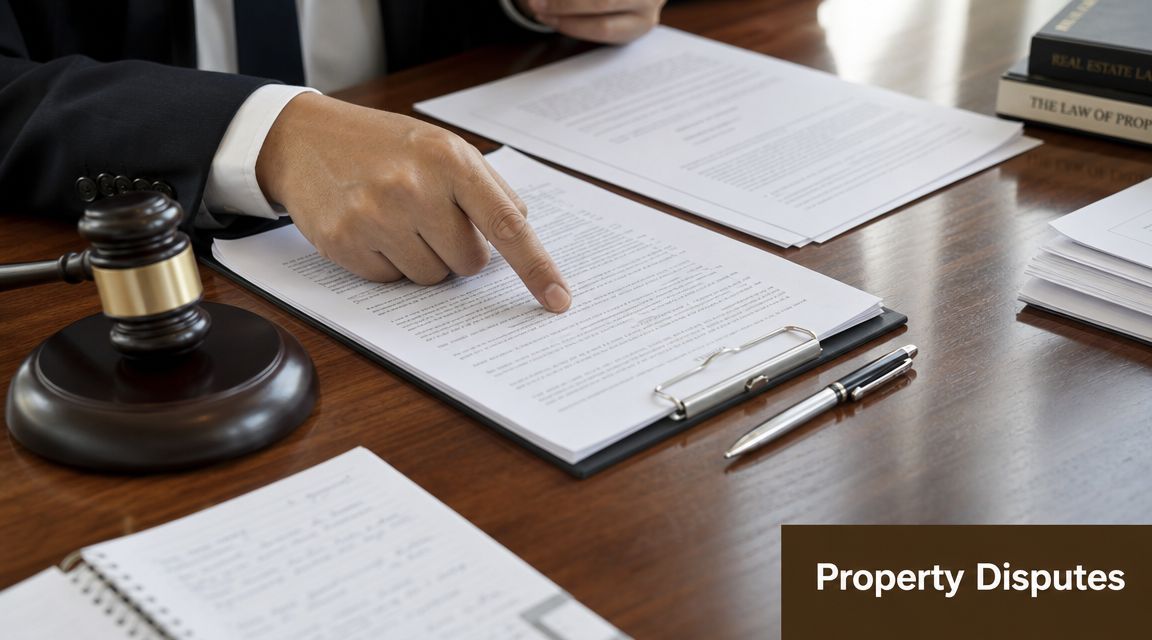
When title fights become lawsuits
In California, one of the most common co-ownership disputes is a partition action. One owner wants out, another wants to keep the property, and there's no agreement on buyout terms or sale timing. If the owners can't resolve it, the court may be asked to divide or sell the property.
A quiet title action is different. That lawsuit is used when ownership itself is disputed or clouded. Common examples include a defective deed, an ambiguous vesting description, an unrecorded claim, or a transfer that didn't properly reflect the owners' intent.
These disputes often start with ordinary events:
- A refinance problem: the lender spots inconsistent vesting.
- A probate filing: heirs discover the deed doesn't match the estate plan.
- A breakup: one owner claims there was an oral side agreement about ownership shares.
Small deed errors can turn into major leverage points once relationships break down.
Creditor pressure changes the stakes
Creditor claims also expose the practical difference between title forms. As explained in Palm City Lawyer's discussion of creditor reach in co-ownership, property held as tenancy by the entirety is generally insulated from the judgment creditor of only one spouse, whereas in joint tenancy the same property is vulnerable if either co-owner is sued. That's one reason TBE is materially stronger for asset-protection planning in states that recognize it.
For California homeowners, that comparison matters because it highlights what joint tenancy does not protect against. If a California owner assumes joint tenancy creates a built-in creditor shield, that assumption can fail very quickly once a judgment is recorded or a bankruptcy issue appears.
In real life, litigation risk rises when title and expectations don't match. A deed should answer basic questions clearly: who owns what, what happens at death, can one owner transfer out, and does the vesting still fit the family's current plan? When those questions were never addressed at the start, they often surface later in court.
How to Choose and Update Your Property Title
The best vesting choice depends on who owns the property, what they want to happen at death, and how much flexibility they need while alive. In California, I usually tell families to stop looking for a universal “best” deed. There isn't one. There's only the title form that best matches the ownership goal.
Common California scenarios
For married couples buying a primary residence in California, community property with right of survivorship often deserves serious consideration because it combines survivorship with California-friendly marital property treatment.
For unmarried partners, siblings, or parent-child buyers who want the survivor to take ownership automatically, joint tenancy may be the cleaner fit. It's simple, familiar, and built around survivorship.
For investment partners or co-owners contributing uneven amounts, tenancy in common is often more practical than joint tenancy because it allows separate shares and doesn't force survivorship.
A few examples of deed vesting language make this easier to visualize:
- Joint tenancy: “John Doe and Jane Roe, as joint tenants”
- Community property with right of survivorship: “John Doe and Jane Doe, husband and wife, as community property with right of survivorship”
- Tenancy in common: “John Doe, a 60% interest, and Jane Roe, a 40% interest, as tenants in common”
Changing title the right way
Families often need to update title after marriage, divorce, a refinance, estate planning, or trust creation. People often get into trouble by assuming a quick deed is enough. It often isn't.
Trust planning creates a recurring complication. As noted in the Illinois State Bar Association article on tenancy by the entirety and trusts, some states have updated their laws so trust-held property can retain TBE status, but the answer depends heavily on state statutes, deed wording, and trust provisions. That point matters in California because homeowners often ask whether moving a home into a revocable trust changes the underlying protections or ownership consequences. The answer depends on the deed, the trust, and California law. It should be reviewed before recording anything.
A practical checklist helps:
- Match title to the relationship. Married, unmarried, inherited, and investment ownership call for different analysis.
- Review taxes before signing. In California, deed choice can affect basis treatment later.
- Coordinate title with the estate plan. The deed, trust, and will should tell the same story.
- Revisit title after major life events. Marriage, divorce, death, and buyouts all justify a fresh review.
Frequently Asked Questions about California Property Co-Ownership
Can I transfer jointly owned property into a trust
Sometimes yes, but it has to be done carefully. A transfer to a revocable trust can affect how title operates, and the deed language matters. In California, the answer depends on the exact vesting, the trust terms, and what result you want on death and during incapacity.
Does joint tenancy replace a will
No. Joint tenancy can control what happens to that specific asset through survivorship, but it doesn't replace a complete estate plan. It doesn't manage everything else you own, and it doesn't provide the broader instructions a will or trust can provide.
What if we later marry or divorce
If unmarried joint tenants later marry, they should review whether the title still matches their goals under California law. If spouses divorce or separate, a survivorship-based title may no longer fit at all. The deed should be reviewed with the rest of the property settlement and estate planning documents.
Many title problems begin with a good intention and a rushed deed. California law gives families useful options, but the right option depends on your facts, not a generic online summary. If you own property in Orange County or Los Angeles and want clarity about joint tenancy, community property with right of survivorship, probate risk, or deed changes, get legal advice before signing a transfer that's hard to undo.
Tanner Law helps California families and property owners make sense of title, probate, and real estate disputes with practical, direct advice. If you're deciding how to hold title, updating a deed after marriage or divorce, dealing with a co-owner conflict, or trying to avoid future probate problems, schedule a free consultation to discuss your situation.