Attorney Breach of Fiduciary Duty: A California Guide
A family meeting about a trust can change quickly. A widowed mother in Orange County may hire the lawyer her family has trusted for years to prepare a living trust and pour-over will. After her death, the children may discover that the attorney named himself successor trustee and directed part of the inheritance to his own children. The family's concern isn't just that the documents were poorly drafted. The concern is that the lawyer used a position of trust for personal advantage.
That situation raises an attorney breach of fiduciary duty claim under California law. The central questions are practical: Did an attorney-client relationship exist? What duty did the lawyer owe? What conduct violated that duty? Can the client connect the violation to a loss or other remedy?
California claims often turn on documents, timelines, account records, disclosures, and communications. This guide explains the framework in plain language, with particular attention to probate, trust, and real estate disputes in Orange County and Los Angeles County.
Table of Contents
- When Your Lawyer's Loyalty Breaks Down
- The Four Elements Every California Claim Must Prove
- How California Treats Attorney Fiduciary Duty Compared to Other States
- Common Fact Patterns in Probate and Real Estate Matters
- Client Remedies and How Compensation Is Calculated
- Defenses Lawyers Commonly Raise and How to Address Them
- Steps to Take Before Filing a Claim in Orange or Los Angeles County
When Your Lawyer's Loyalty Breaks Down
The relationship creates more than ordinary duties
Once the attorney accepts the representation, the lawyer owes the client duties of loyalty, honesty, confidentiality, communication, and fair dealing. California's professional rules address client communication and serious professional misconduct, including the lawyer's obligation to keep a client informed of significant developments under California Business and Professions Code section 6068 and related California ethics guidance.
The fiduciary relationship is broader than a promise to perform competent legal work. A lawyer may breach fiduciary duty even when the legal document itself is technically valid. The problem may be an undisclosed conflict, personal self-dealing, misuse of confidential information, or failure to tell the client about a material development.

Where the loyalty breaks
Return to the Orange County trust scenario. The attorney should have explained any proposed appointment that could benefit the lawyer personally. The mother should have received a clear disclosure, a meaningful opportunity to ask questions, and advice that placed her interests ahead of the attorney's interests. Depending on the circumstances, independent counsel may have been appropriate.
Instead, the lawyer placed himself in control of trust property and diverted inheritance toward his own family. That alleged conduct is different from making a drafting mistake, missing a filing deadline, or giving incorrect legal advice. Those errors may support a malpractice theory if they caused harm. Self-dealing and concealed personal benefit point directly toward disloyalty.
Practical rule: A conflict becomes especially serious when the attorney gains something the client wasn't told about and the client had no fair chance to evaluate.
The modern attorney-client fiduciary framework developed from older equity principles and English legal traditions. Legal scholarship traces lawyers' duties of fairness, honesty, confidence, and undivided loyalty to those historical foundations, rather than treating fiduciary obligations as a recent invention. This historical analysis of attorney fiduciary duties helps explain why California courts examine the attorney's conduct closely.
A strong claim still requires disciplined proof. The sections that follow address the four-part liability chain, common estate and real estate fact patterns, remedies, defenses, and the evidence a client should preserve before filing suit.
The Four Elements Every California Claim Must Prove
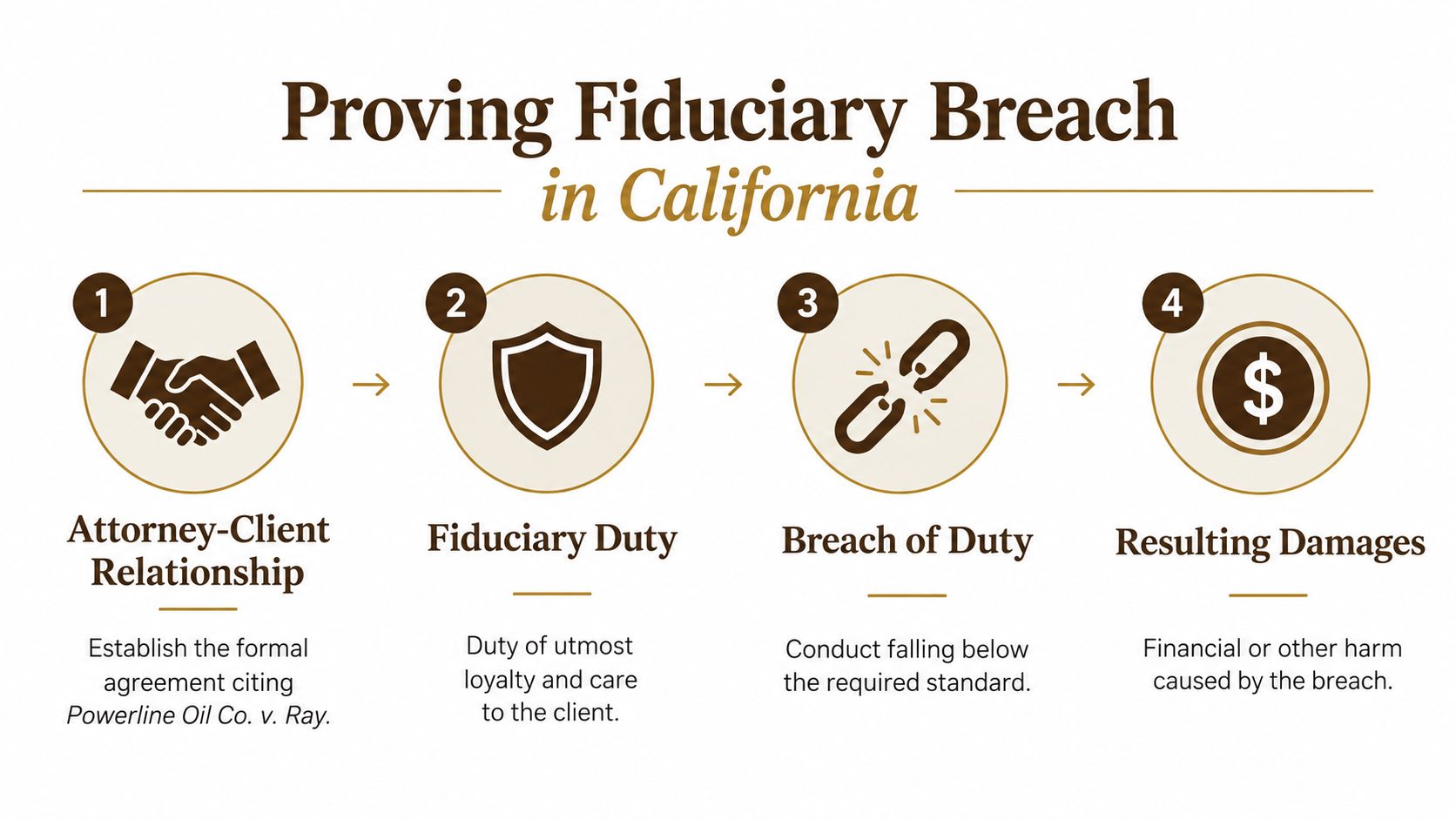
A California attorney fiduciary-duty case is usually tested through four connected questions. The chain matters because a troubling act, standing alone, may not establish a recoverable civil claim.
First, establish the relationship
The client must show that the attorney-client relationship existed for the matter at issue. An engagement letter, retainer payment, emails, invoices, trust drafts, court filings, or advice given during a consultation may help prove it. California authority such as Powerline Oil Co. v. Superior Court examines whether the lawyer undertook to provide legal services to the person asserting the claim.
In a probate matter, the signed engagement letter may show that the attorney represented the trustee, the beneficiary, or the decedent. Those roles aren't interchangeable. A beneficiary who received general information from the lawyer may not have the same claim as the person who hired and paid the lawyer.
Second, identify the fiduciary duty
The attorney must owe a duty of loyalty and fair dealing to the claimant. California courts describe the lawyer's obligation as demanding the highest level of fidelity. In Oasis West Realty, LLC v. Goldman, the California Supreme Court addressed the importance of loyalty when a lawyer's interests conflict with a former client's interests.
For example, a lawyer representing a property owner shouldn't secretly use confidential information about the owner's urgent need to sell to acquire the property for personal benefit. The attorney's knowledge and position can make an otherwise ordinary transaction extremely unfair.
Third, show the breach
A breach may involve self-dealing, an undisclosed conflict, misuse of confidential information, failure to communicate, mishandling client funds, or taking a position adverse to the client without proper consent. Herbert v. Litchfield is among the California authorities addressing fiduciary misconduct and the consequences of an attorney's divided loyalty.
The evidence might be a title record showing a transfer to the lawyer, an email revealing an undisclosed relationship, or a trust accounting that omits property. The client doesn't need to label the conduct perfectly at the beginning. The facts must show what the lawyer did, what the lawyer failed to disclose, and why that conduct was inconsistent with the client's interests.
Fourth, connect the breach to a remedy
Causation and damages complete the claim. Stanley v. Richmond reflects the principle that a client must connect the wrongful conduct to a loss or legally available remedy. A lawyer's bad conduct doesn't automatically establish that the client lost money.
A beneficiary might need to show that a concealed transaction reduced the inheritance. A property owner might need an appraisal or transaction analysis to show that an undisclosed conflict affected the sale price. Fiduciary claims can also support equitable remedies, including fee forfeiture, even when traditional economic damages are difficult to prove.
The same underlying facts may support tort and contract theories. Fiduciary claims can be especially important because courts may consider equitable relief, disgorgement, or fee forfeiture, rather than limiting the client to a conventional negligence measure.
How California Treats Attorney Fiduciary Duty Compared to Other States
California shares core fiduciary principles with national authorities, but its practical rules can be demanding for lawyers who represent clients in trust, property, and transactional matters. The Restatement and ABA Model Rules provide useful reference points. California's own rules and decisions control California claims.
The differences that matter in practice
California places substantial weight on loyalty, confidentiality, informed consent, and the attorney's obligation to avoid divided interests. A written conflict waiver won't necessarily solve the problem if the lawyer failed to disclose the relevant facts clearly or the client lacked a meaningful basis for consent.
California also recognizes that self-dealing can justify a strong inference of injury or equitable relief. That doesn't eliminate the need to analyze causation and the requested remedy. It does mean a lawyer may face consequences for disloyal conduct even when the client can't calculate every resulting loss with precision.
Federal courts hearing state-law claims in diversity cases must apply California substantive law, but federal procedural decisions and interpretations can affect how claims are presented. Punitive damages, privilege questions, and pleading standards require careful analysis rather than assumptions based on another state's practice.
| Issue | California | Restatement / Other States |
|---|---|---|
| Loyalty | California demands strict loyalty and careful handling of conflicts in the attorney-client relationship. | The Restatement and ABA Model Rules also treat loyalty and conflicts as central, but application varies by jurisdiction. |
| Conflict consent | Disclosure must be meaningful and sufficiently complete for consent to matter. | Other jurisdictions may apply different standards to written waivers and informed consent. |
| Self-dealing | California authority allows serious consequences and may treat disloyal conduct as presumptively injurious in appropriate circumstances. | Other states may require a more developed showing of economic injury before granting comparable relief. |
| Non-client duties | California courts have narrowed some claims by people who weren't clients, while recognizing duties in particular reliance or intended-beneficiary settings. | States use different tests for whether a lawyer owes duties to beneficiaries, counterparties, and other outsiders. |
| Damages | Courts separate fiduciary remedies from ordinary malpractice damages and examine the loss caused by the breach. | Other jurisdictions differ on fee forfeiture, punitive damages, and available equitable relief. |
A useful illustration comes from modern dispute systems. FINRA reported 1,518 breach-of-fiduciary-duty cases at year-end 2024, compared with 1,340 in 2023 and 1,252 in 2022; through July 2026, the figure was 751, compared with 786 during the same period of 2024. FINRA's dispute-resolution statistics show that fiduciary allegations remain a recurring category in financial and professional disputes. The figures don't decide a California attorney case, but they show why careful pleading and evidence remain important.
Common Fact Patterns in Probate and Real Estate Matters
A trust administration with a hidden transaction
A family hires an attorney to prepare a trust and transfer a Long Beach rental property into it. After the settlor dies, the attorney assists with administration and communicates with a co-trustee about the property. The beneficiaries later learn that the attorney privately negotiated a buyout from the co-trustee while billing the estate for work connected to the same transaction.
The issue isn't merely whether the buyout was financially sensible. The family would ask whether the lawyer represented the estate, a trustee, or individual beneficiaries, whether the lawyer disclosed the personal transaction, and whether the estate paid for work that advanced the attorney's own position.
The evidence chain may include:
- Engagement materials: The original agreement may identify the client and the scope of representation.
- Billing records: Invoices can show whether the estate paid for work benefiting the attorney personally.
- Email threads: Messages may reveal when the attorney discussed the buyout and what was disclosed.
- Title records: Deeds and recorded transfers can show who acquired the property and when.
- Trust accountings: Statements may identify payments, credits, or omissions affecting beneficiaries.
The four elements must still be connected. The engagement letter supports the relationship. The attorney's role supports the duty. The secret buyout and billing may show breach. An appraisal, accounting, or comparison of the transaction terms may establish the financial effect or support an equitable remedy.
A real estate deposit handled through an IOLTA account
A Pasadena couple retains an attorney during a Sherman Oaks purchase. The attorney holds deposit money in an IOLTA account, but the clients later discover that funds were commingled and used for personal expenses before the transaction closed.
California ethics guidance requires lawyers to notify clients when property is received, identify and safeguard it, keep complete records and accounts, follow audit requirements, and promptly deliver money the client is entitled to receive. California Bar guidance on client property provides a practical checklist for examining the attorney's handling of funds.
The clients would preserve bank records, trust-account ledgers, closing statements, wire confirmations, and written instructions. They'd also identify whether the misuse delayed closing, caused a contractual penalty, threatened the deposit, or produced another concrete loss.
Evidence often answers the legal question. A ledger can show where money went, while a title record can show who received the benefit.
Neither scenario should be treated as proof merely because the facts sound unfair. California courts examine the relationship, disclosure, conduct, causation, and remedy. A careful review of the original file usually matters more than a conclusion based on one alarming document.
Client Remedies and How Compensation Is Calculated
A successful claim may produce more than a check for an economic loss. The remedy depends on the type of misconduct, the evidence, and the connection between the breach and the relief requested.
Fee forfeiture and equitable disgorgement
A court may order an attorney to return fees when the lawyer's disloyal conduct makes retention of those fees inequitable. This remedy focuses on the attorney's right to keep compensation, not only on whether the client can prove a precise investment loss.
For example, if a lawyer secretly represented conflicting interests while charging the estate for the work, the client may argue that the lawyer shouldn't retain some or all of the fees tied to the conflicted representation. The requested amount depends on the record and the court's equitable analysis.
Compensatory and consequential loss
Compensatory damages generally seek to place the client in the position the client would have occupied without the breach. In an estate dispute, the analysis may involve the inheritance value that was lost or diverted. In a real estate dispute, it may involve diminished equity, lost transaction value, restoration costs, or expenses incurred because the lawyer mishandled funds.
The technical benchmark is loss proximately resulting from the wrongful conduct. Courts may require a counterfactual analysis, meaning evidence of what probably would have happened if the lawyer had disclosed the conflict, preserved the funds, or acted loyally. This analysis of causation and damages in fiduciary claims explains why expert testimony and financial reconstruction can become important.
Punitive damages and fee disputes
Punitive damages are not automatic. California Civil Code section 3294 requires proof of oppression, fraud, or malice under the governing standard. A client should separate an allegation of intentional self-dealing from the evidence needed to support punitive relief.
Fee arbitration presents a separate procedural question. A fee dispute may fall within the State Bar's Mandatory Fee Arbitration framework under Business and Professions Code section 6200. Whether arbitration must occur before a court action depends on the claim, the parties, and the relief sought.
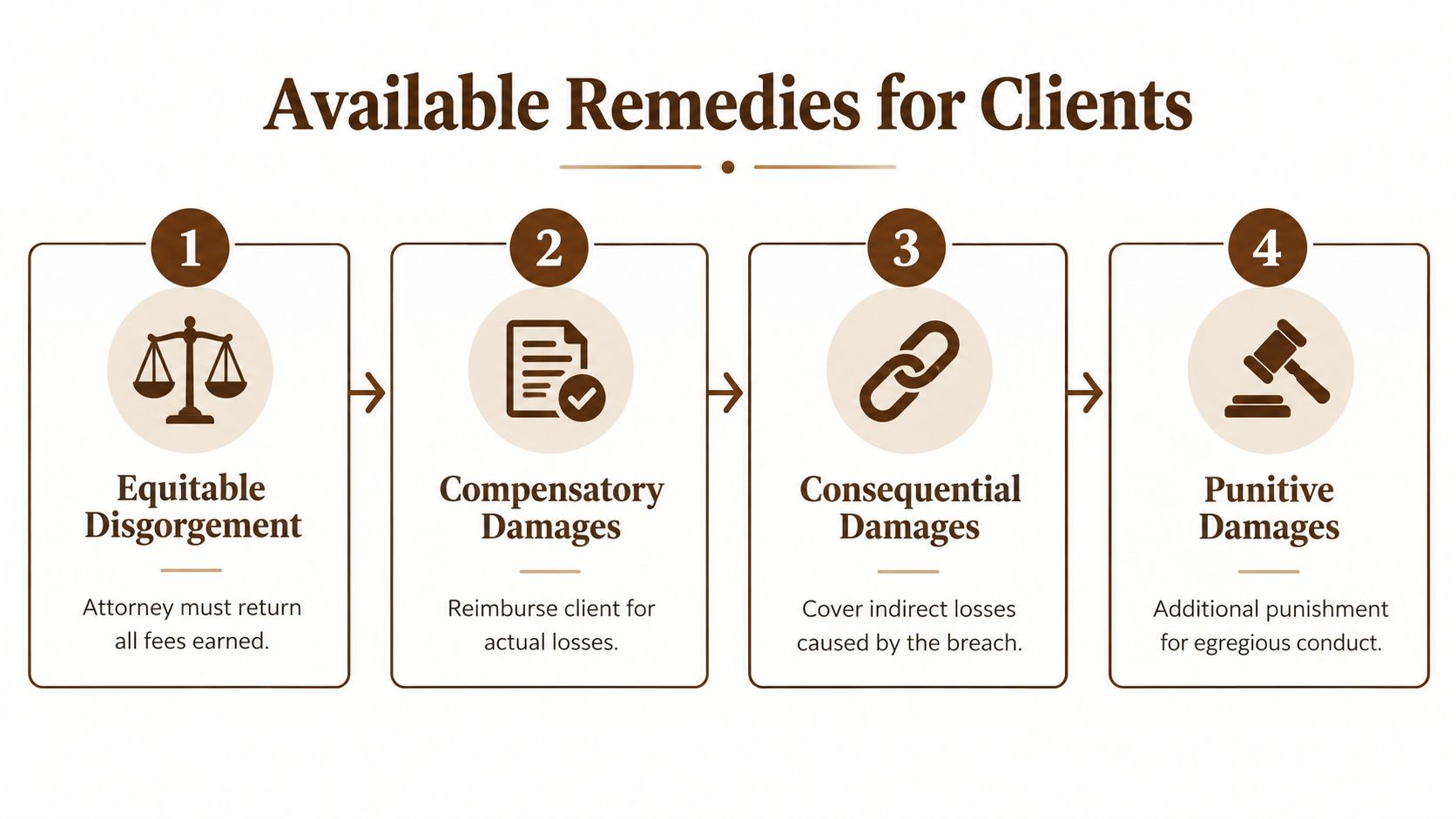
Build the damages file early
Preserve appraisals, bank statements, trust accountings, closing disclosures, invoices, tax records, and property valuations. A forensic accountant may help reconcile deposits and withdrawals, while a real estate appraiser may address property value. The goal is to give the attorney a defensible calculation rather than an estimate based on frustration or suspicion.
Defenses Lawyers Commonly Raise and How to Address Them
A lawyer defending an attorney fiduciary-duty claim will often focus on timing, consent, causation, privilege, or the client's own conduct. These defenses can succeed when the file is incomplete. They can also weaken when contemporaneous records show what the lawyer knew and what the client was told.
Timing and discovery
California deadlines vary by claim characterization. California legal-malpractice claims commonly involve Code of Civil Procedure section 340.6, which generally requires suit within one year after the client discovers, or reasonably should discover, the facts of the wrongful act, and no later than four years after the act or omission, subject to tolling exceptions. California appellate authority discussing section 340.6 explains the importance of the discovery rule and statutory limits.
A lawyer may argue that the client knew enough to sue earlier. The response depends on the actual timeline. Preserve the date of each disclosure, account statement, property record, email, and conversation that might establish when the facts became reasonably discoverable.
Privilege and consent
Civil Code section 47(b) can protect certain communications connected with judicial proceedings, but it doesn't automatically immunize every act involving a dispute. A communication made for advocacy may receive different treatment from conduct used to conceal a personal transaction, move client funds, or obtain property.
The lawyer may also claim good faith, informed consent, or ratification. A signature alone may not prove informed consent if the lawyer withheld material facts or didn't recommend independent advice where the conflict made that advice important.
| Defense Raised | California Authority | Effective Counter Strategy |
|---|---|---|
| Statute of limitations | Code of Civil Procedure section 340.6 and discovery-rule cases | Build a dated timeline showing when the client learned the material facts. |
| No attorney-client relationship | California relationship principles, including Powerline Oil | Preserve engagement letters, invoices, legal drafts, and communications identifying the representation. |
| Informed consent | California conflict and ethics rules | Compare the written disclosure with the actual conflict, benefits, risks, and missing facts. |
| Litigation privilege | Civil Code section 47(b) | Separate protected advocacy from non-advocacy conduct such as concealed self-dealing or fund misuse. |
| No causation | California fiduciary and malpractice authorities | Use account reconciliations, appraisals, transaction records, and expert analysis to connect conduct to loss. |
| Ratification or unclean hands | Equitable principles | Show what the client knew at the time and whether the lawyer provided complete information. |
California law also imposes reporting obligations on attorneys who learn of certain serious professional misconduct. A civil judgment involving fraud, misrepresentation, breach of fiduciary duty, or gross negligence in a professional capacity is among the matters addressed by Business and Professions Code section 6068. The reporting rule is separate from a client's civil claim, but it reinforces the seriousness of proven professional misconduct.
Steps to Take Before Filing a Claim in Orange or Los Angeles County
A careful pre-litigation investigation can preserve evidence, clarify the client relationship, and prevent avoidable procedural mistakes. Start with the file, not with accusations.
Collect the core documents
Gather the engagement letter, amendments, invoices, payment records, trust drafts, deeds, escrow instructions, accountings, closing papers, and court filings. Save original electronic files where possible. Don't edit emails, rename files in a way that destroys context, or rely only on screenshots.
Create a chronology that identifies the date of each major event. Include the date the lawyer was retained, important instructions, disclosures, transfers, account statements, and the moment the suspected misconduct became known.
Identify people and obtain official records
List every person who may have relevant knowledge. That may include the drafting attorney, another lawyer in the firm, a paralegal, trustee, beneficiary, accountant, escrow professional, title representative, or real estate broker.
For a probate case, obtain the relevant court file from the probate clerk and review petitions, inventories, accountings, orders, and recorded property documents. For a real estate dispute, collect title records, escrow materials, payment confirmations, and communications with the lender or title company.
A client may also request the attorney's available client ledger and related records, subject to applicable procedures and privacy limits. Financial records should be compared against invoices and closing documents, not reviewed in isolation.
Address fee arbitration and obtain a conflicts-cleared review
If the dispute includes attorney fees, examine whether the State Bar fee-arbitration process applies before filing a civil action. Orange County matters may involve the Lamoreaux Justice Center, while Los Angeles matters may involve the Stanley Mosk Courthouse, along with applicable local procedures. The precise filing path depends on the dispute, so a lawyer should evaluate it before a deadline passes.
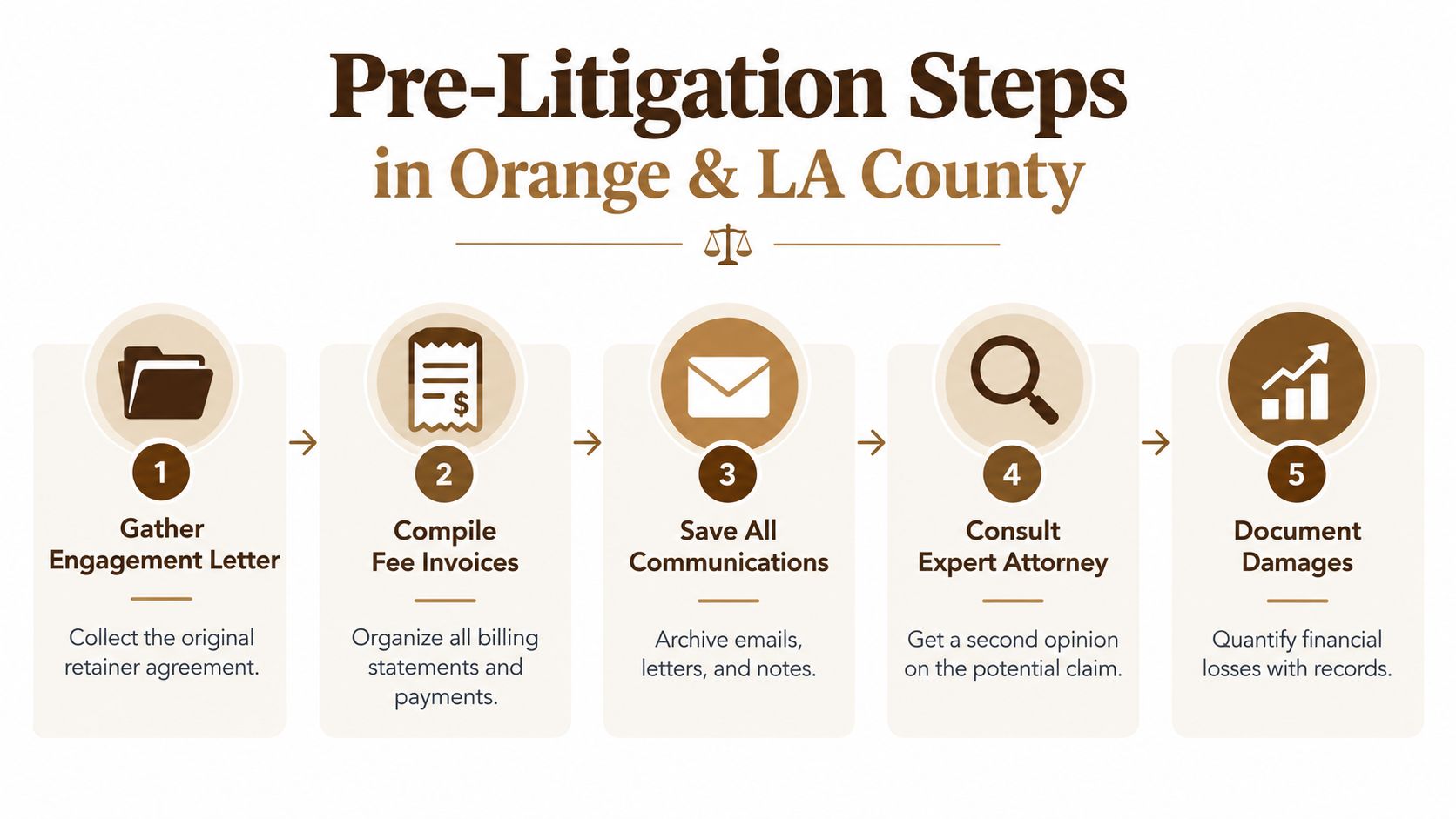
Don't send a demand letter before confirming that the recipient's firm doesn't have a conflict and that the letter won't reveal protected information unnecessarily. A confidential consultation can help separate a fiduciary-duty claim from malpractice, fee arbitration, probate objections, or a property-related claim.
Before filing, answer three questions in writing: What relationship existed, what act violated loyalty, and what remedy can the evidence support?
Tanner Law helps Orange County and Los Angeles clients evaluate attorney misconduct alongside probate, trust, and real estate disputes, with practical attention to documents, ownership records, and financial harm. Schedule a free consultation by visiting Tanner Law to discuss the facts, preserve your options, and determine the next step.